
Yesterday’s sure bets are gone already, as voters test new options. PM Carney has skilfully surfed that political wave.
The last year has been very dynamic for both Canadian and Quebec politics.
Since December 2024 and the forced retirement of Justin Trudeau, new PM Mark Carney – a man with no history in electoral politics — has steadily consolidated his hold on power.
Meanwhile, Quebec’s political scene has been entirely reshaped. Parties have quickly risen and fallen in public polling. Two new leaders have set the stage for a three-party horse race in the upcoming October election.
Given these sudden changes, I want to update my political take from last November in Townships Weekend (“Canada faces hot political season in 2026”).
Liberals return full force
Back on November 4th, 2025, after six months of governance, Mark Carney introduced the Liberals’ first budget. The Opposition was cranky and complained loudly about the long wait for a financial reckoning. The Conservatives still held the allegiance of nearly 40 per cent of the Canadian electorate.
Over the winter, however, voter satisfaction with Carney and his government’s anti-tariff, interventionist budget rose. And disappointment with Conservative leader Pierre Poilievre’s performance simmered.
Then came a humiliating dénouement.
First one, then several other, Conservative MPs were enticed to join the governing Liberals. Floor crossings came in bursts in early April. Added to three byelection wins, this put the Liberals in control of Parliament.
I observed the peak of this trend on April 8-9 when the Liberal Party of Canada held its convention at the Palais des Congrès in Montreal. The gathering featured strong representation from the multicultural Toronto suburbs, a stream of media-savvy Liberal ministers, from François-Philippe Champagne to Marc Miller, and many happy party loyalists.
The prime minister was reaching a new apex of power and popularity.
When a leader’s support is on the upswing, they can do no wrong. When you’re hot, you’re hot.
So, when Carney attended a showdown hockey game between the Canadiens and rival Tampa Bay Lightning that week, a delirious crowd applauded along with him as sniper Cole Caufield scored his 50th goal. Pundits quipped that, given Carney’s recent luck, some opposing players might have been tempted to switch teams after the game.
In his closing speech to Liberals that weekend, an exuberant Carney highlighted “building and investment”, and patted party activists and ministers on the back for their good deeds.
One Quebec commentator, Mario Dumont, while noting Carney’s professional skills, nonetheless argued that “Carney is a creation of Trump”. His rapid ascension as head of the Liberal Party and their subsequent, turbocharged rise to victory were all premised on an economic threat from the United States.
Fair enough, noted Dumont, but the issues of cost of living and public safety that propelled the Conservatives to big polling leads in 2024 have not disappeared. They may just be dormant.
These are not the policy issues, however, that animated the Liberal base at this convention. Delegates passed resolutions defending national producers against U.S. tariffs. Motions to “enforce the Canada Health Act” aimed to slow or stop the establishment of private healthcare services across the country. The notwithstanding clause came in for sustained abuse (with few mentioning that it was adopted under a Liberal prime minister). Proposals to oppose its use by provinces from West to East — in Alberta, Ontario and Quebec – echoed frustration at obstreperous provinces overriding Charter rights. Resolutions were also passed to limit underage access to social media and AI to prevent any social harms.
Meanwhile, the cost-of-living issue looms ominously. As an Angus Reid poll in early May reported, 52 per cent of Canadians remain dissatisfied with the Liberals’ results in that area. Carney’s popularity is not guaranteed or eternal.
Quebec scene explodes
Meanwhile, over the last six months the Quebec political scene has burst into energized factions. A multiparty competition in 2026 now seems inevitable.
Quebec is notorious for quickly switching political favourites. On election night, red waves often succeed blue ones, interspersed with orange or light-blue waves. The palette is never fully coloured.
Consensus opinion in late 2025 viewed the Parti Québécois as headed for victory. Its lead in the polls had held steady since the governing CAQ’s misadventures with Quebec City commuter-transit issues in fall 2022. The public was broadly fed up.
In 2025 the provincial Liberals elected a new leader, Pablo Rodriguez, whose appeal was soon questioned. He led a party with little francophone support. Rodriguez was ousted (after charges of corruption), and the Liberals were still widely considered too weak to really matter.
It is worth recalling the Quebec Liberals’ upset win back in 2014, another occasion when the Montreal media was certain of a PQ victory. Sure enough, the Liberals have recently shown momentum under an attractive new leader, Charles Milliard of North Hatley (who will run in Orford riding).
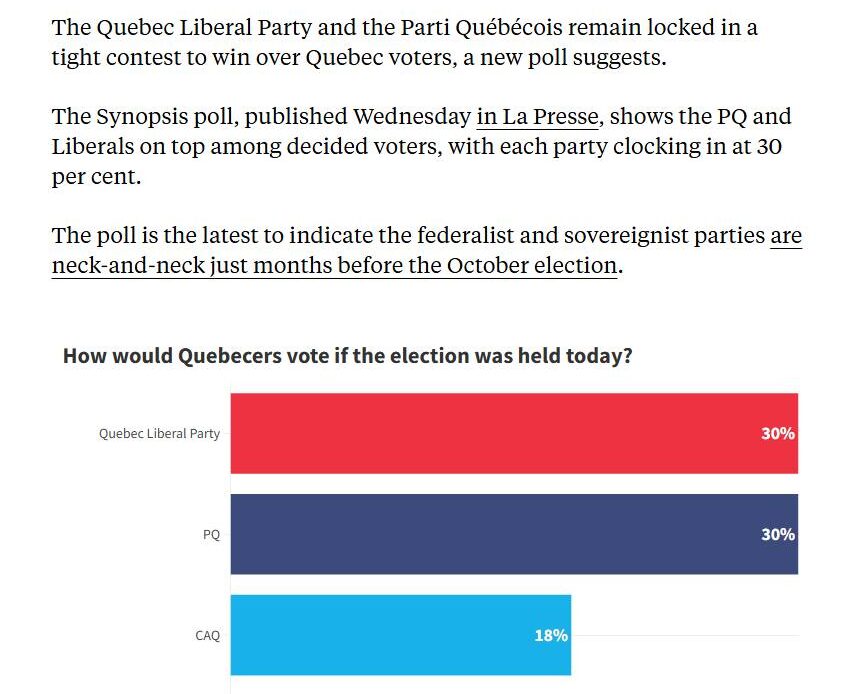
Meanwhile, Parti Québécois leader Paul St-Pierre Plamondon, known by initials PSPP, has not managed to stop his party’s recent slide. PQ support has dipped visibly under the weight of its leader’s sovereignty obsession. As the Montreal Gazette reported on May 13:
Surprisingly, there has also been an ideological shift among Quebec artists, students and academics: the PQ has become a “bogeyman” of the woke Left.
Acerbic commentator Richard Martineau, writing in the Journal de Montréal, commented wryly that PSPP is being painted as the Trump of Quebec: backing anti-immigrant measures, decrying DEI-like policies, and pushing for a pro-natalist policy that might edge women back into the home.
No, it’s not the PQ of René Lévesque anymore.
As for the Coalition avenir Québec of François Legault, it looked frazzled in early 2026, with polls suggesting it might elect zero MNAs. But even the CAQ has seen its perspectives change abruptly, with the election of a refreshing new leader, Christine Fréchette. She is an experienced minister without many of the hard edges of old-school paternalist Legault.
Fasten your seatbelts. The wild ride in Quebec and Canadian politics is just beginning.
