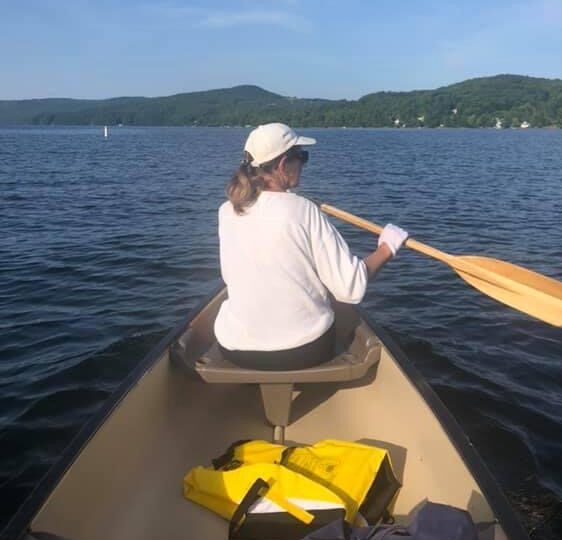
After decades of a boating hiatus, I finally got back on the water
Have you ever had an interest that was all-consuming, but that then … disappeared? Maybe you once played chess regularly, or shot hoops, or even groomed dogs and cats?
Then that activity just sorta vanished. Poof! It wasn’t that you disliked your pastime, but often life moves on and old habits go with it. That’s my story with boating.
Summer and boats went together for me. I always enjoyed some kind of boating during warm-weather days in Canada. Never a powerboat, and no motors. I always had a horror of big boats’ spray and sending surf waves in all directions. And I did little fishing or racing, mostly just paddling around.
But there was a long gap in there. Several decades when I almost never got on the water in any type of small craft, canoe or kayak. Recently, that has all turned around.
Canoeing adventures
Somewhere in the late 1950s my father acquired a bright red, 16-foot cedar-strip canoe. I still recall vividly the smell of cedar wood and the smooth weave of the wicker seats. We paddled that canoe many summers on Lake Simcoe in southern Ontario.
The Winch family habitually owned smaller European cars that were dwarfed by an outsized canoe on the roof, and we did not always have a suitable rack to transport one. No cottage, either. Eventually, after not getting much use for decades, the canoe mostly adorned our garage wall.
As a young teen, I somehow accumulated $100 once at a summer job. My dream was to immediately purchase a sailboat at Canadian Tire — a thick-Styrofoam hull adorned with a triangular sail, called a Snark. It was absolutely unpretentious but still seaworthy. I happily sailed it close to shore in Lake Ontario and on the St Lawrence River near the Thousand Islands. (Recently, I googled the Snark and it found still has fans.)
My resourceful mother, sensing this interest, helped me dramatically improve those sailing skills. In the summer of 1970, she signed me up for a sail-training vessel, the brigantine St. Lawrence II, a huge 72-foot two-master docked at Kingston, Ontario. The young crew quickly learned the ropes, literally, and we sailed off around Lake Ontario.
Trust me, that Great Lake is an inland sea. On one crossing, we endured huge storm waves, whose blue-green valleys sucked the bow steeply downward then channelled rivers of wash and foam across the deck. It is surprising we all got through those storms and big rollers without any kids getting swept off the deck.
Becoming more cautious, I took to small-boat sailing at Camp Kandalore on a lake in Ontario’s Haliburton region. There I became a regular skipper on smallish Albacore-class sailboats. Profiles describe them as “a 4.57 m (15 ft) two-person planing dinghy”. Calling them a dinghy seems a bit insulting, but an Albacore could be handled by a small crew of friends and was fun to race occasionally. Albacores are known for their sloop rig, deep centreboard and rudder, making them highly maneuverable.
Skippers have to develop a sense of wind direction and how to trim the sails accordingly. “Helms-a-lee! Ready to come about!” was my nautical-sounding refrain at the tiller.
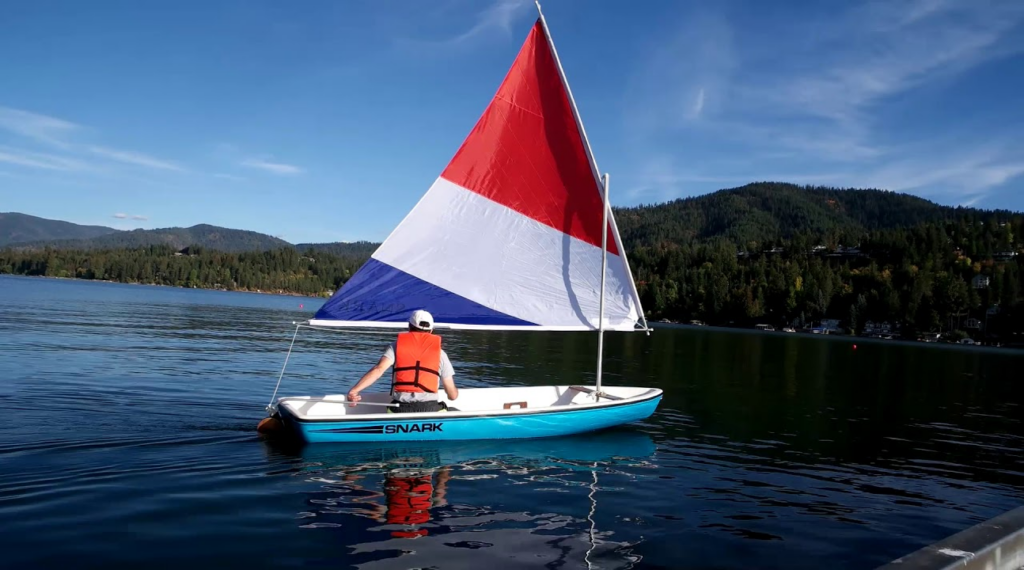
Tiny sailing craft Snark was my first step into the sailing world ….
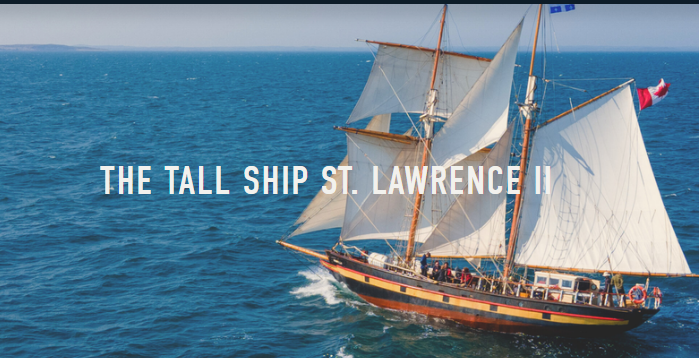
….. followed by a cross-Great Lake adventure on brigantine based in Kingston, Ont.
Later in the 1970s I took ambitious canoe-trips at the same summer camp . Veteran woodsmen led trips down distant northern Canadian rivers with fully laden, three-man canoes. These adventures lasted up to a month. My biggest canoe trip was a 28-day paddle in 1972 down the turbulent Albany River across the top of Ontario—a great river which, my Dad quipped, “nobody has heard of”.
Kandalore was also the source for a collection of historic and modern canoes and kayaks, which became the Canadian Canoe Museum in Peterborough Ontario. It is the biggest storehouse of water-going light craft anywhere in the world. (Check it out: www.canoemuseum.ca ).
My boating adventures peaked in 1979. A brash Québécois sterns-man, Luc, challenged me to take on the unpredictable Moisie River from Labrador City down to Quebec’s North Shore. This was a challenge, even with Luc steering our canoe, as we careened through many sets of rapids and fast-moving channels. As a bowman, I was charged with paddling madly to direct the canoe from the front! We plunged down steep drops and through cannonading gullies — places I would never dare to traverse again.
In short: this was nuts. I look back today at the risks we took as twentysomethings and shake my head in astonishment.
Back to the lakes
Then adult life intervened. While working for years in the U.S. and Europe, boating dropped out of sight. On one occasion a friend did invite me to crew on her small sailboat on Lake Geneva. The next day the Swiss yacht club called to say: no non-members allowed!
The closest I got to boating again was probably swimming down the Rhine River for a kilometre or two on flotation devices one July. In short, there were no real boats in my life. A lapsed personal interest, as older people often have. For over thirty years, I did almost no paddling or sailing.
Then recently, things changed. On our move to the Townships, we purchased a very basic but serviceable 16-foot green fiberglass canoe, again at Canadian Tire. It has been good for fun paddles around Lake Massawippi.
One summer, we had access to a beach. We could launch the canoe there, then paddle across the bay to the dépanneur grocery. We later docked most summers at the municipal marina on the Massawippi River. But a canoe is heavy to lift off the racks and increasingly less navigable solo, given my bad knees. As I first learned at canoe camp, kneeling is critical for control when paddling alone.
Hence my switch in 2026 to a kayak, good for one seated paddler doing quick jaunts across the lake with no painful kneeling.
A new boating era has begun. –Ahoy, mate!
Originally published in the Sherbooke Record weekend supplement, July 4, 2026.
