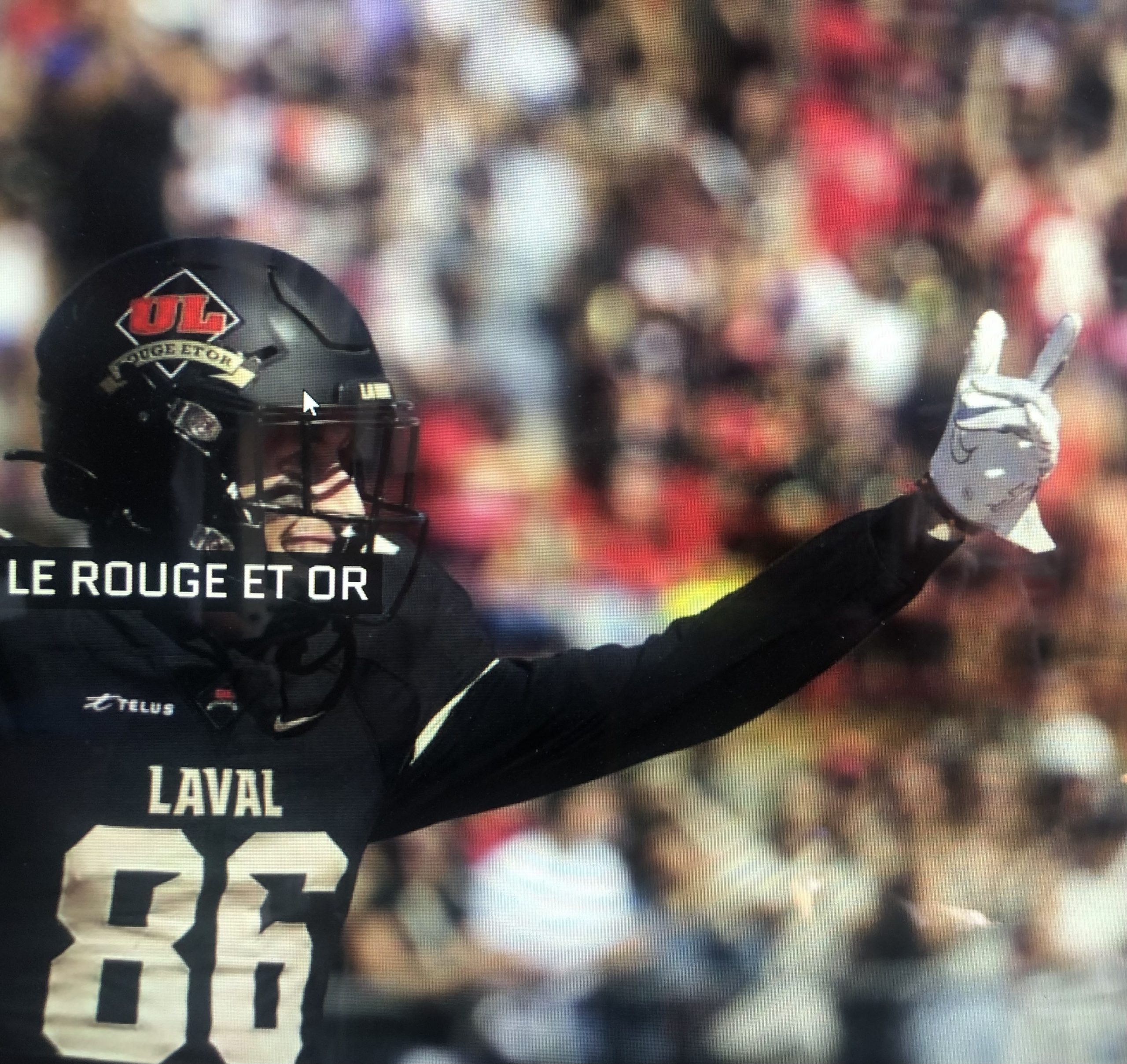
A traditionally anglo sport has exploded among francophone athletes
There’s been a Quiet Revolution in Quebec team sports in recent decades – francophones have started playing football in large numbers.
“Canada is hockey”, people often say, but English Canada has long supported other team sports, too. Every high school across the rest of Canada has traditionally fielded a football team. Not so in Quebec.
Since the 1980s, however, high school, CEGEP and university football has boomed in French Quebec, producing a wave of francophone pro players for the CFL and, to some degree, the NFL.
A snapshot of this new football world occurred on September 15, when a Quebec college showdown was played at Université Laval in Quebec City: almost 19,000 fans cheered as rival university teams Laval and U de Montréal played at Telus stadium. That was more people than attended the CFL game in Montreal between the Alouettes and Toronto Argonauts the night before.
The recent French accent in football is a big change in Canadian sports history.
Anglo origins, nouvelle vague
For a century, “rugby-football” was an all-anglo affair.
Wikipedia reports that “the first written account of a game played was on October 15, 1862, on the Montreal Cricket Grounds … between the First Battalion Grenadier Guards and the Second Battalion Scots Fusilier Guards”. For those keeping score, the Grenadier Guards won, 3 goals and 2 rouges to none. Played at the height of the Victorian era of Empire, you can almost sniff the gin in the post-game toasts.
Rugby-football became more popular. In a factoid every Canadian sports geek learns, McGill challenged Harvard to a two-game series in 1874, using a hybrid style of English rugby devised by McGill. North American “football” was born.
A century later, francophone athletes finally embraced the sport. In 1966, Pierre Desjardins, an offensive lineman, started a six-year career with the Alouettes. Along with linebacker Pierre Dumont, they were likely the first French Canadians to play for the Larks. While Desjardins had gone the traditional sports route, playing for a U.S. college (Wyoming), Dumont was noticed by scouts while playing for the local N.D.G. Maple Leafs.
The Desjardins name was eventually hoisted alongside Alouette all-timers like Sam Etcheverry and Anthony Calvillo on the upper deck at Molson Stadium. But French-speaking players remained a small minority until the 1990s.
Pierre Vercheval, a lineman who played football at CEGEP de Trois Rivières before graduating to the University of Western Ontario Mustangs, was the first French Quebecer to participate in an NFL training camp, in 1988 with the New England Patriots. Vercheval moved on to the CFL, eventually playing for both Edmonton and Montreal and winning two Grey Cups with the Toronto Argos.
After Vercheval reached the pro ranks, things changed fast: in 1993, there were about 5,000 young Quebecers playing football. Today, Football Québec reports there are over 27,000 players in the province — a 450 per cent jump in just three decades.
Regarding this surge in francophone talent, Vercheval told the Globe and Mail’s Dave Naylor in 2005: “I would never have believed it. … When I started in 1988, it was me and one other guy in the league. The Alouettes had just folded the year before and there were no [French] university football programs. I didn’t think it would take off like this.
“In 1980, Quebec City had five high-school football teams in the area. Now, there are well over 50.” And since 2000, French schools have become a growing source of CFL talent.
In 2004, 29 players from Quebec played at least one CFL game. By 2023, there were 13 Quebecers on the Alouettes’ roster and, league-wide, roughly 35-40 francophones playing regularly on CFL rosters
Personalities started getting attention. On the Ottawa team in the early 2000s, three out of four offensive linemen were francophones. They cheerfully dubbed themselves the “Bloc Québécois” and joked that shouting signals in French before the snap gave them an edge on the American linemen they confronted.
Super Bowl winners
One product of an Eastern Townships school, Éric Deslauriers, is now director of football operations with the Alouettes. Deslauriers was born in Gatineau and attended Champlain College in Lennoxville for its 2000 season, where he played quarterback for the Cougars.
He then went to Eastern Michigan U as a wide receiver, before a tryout for the NFL’s Pittsburgh Steelers. Deslauriers was also drafted by the CFL Alouettes, where he played from 2007 to 2015.
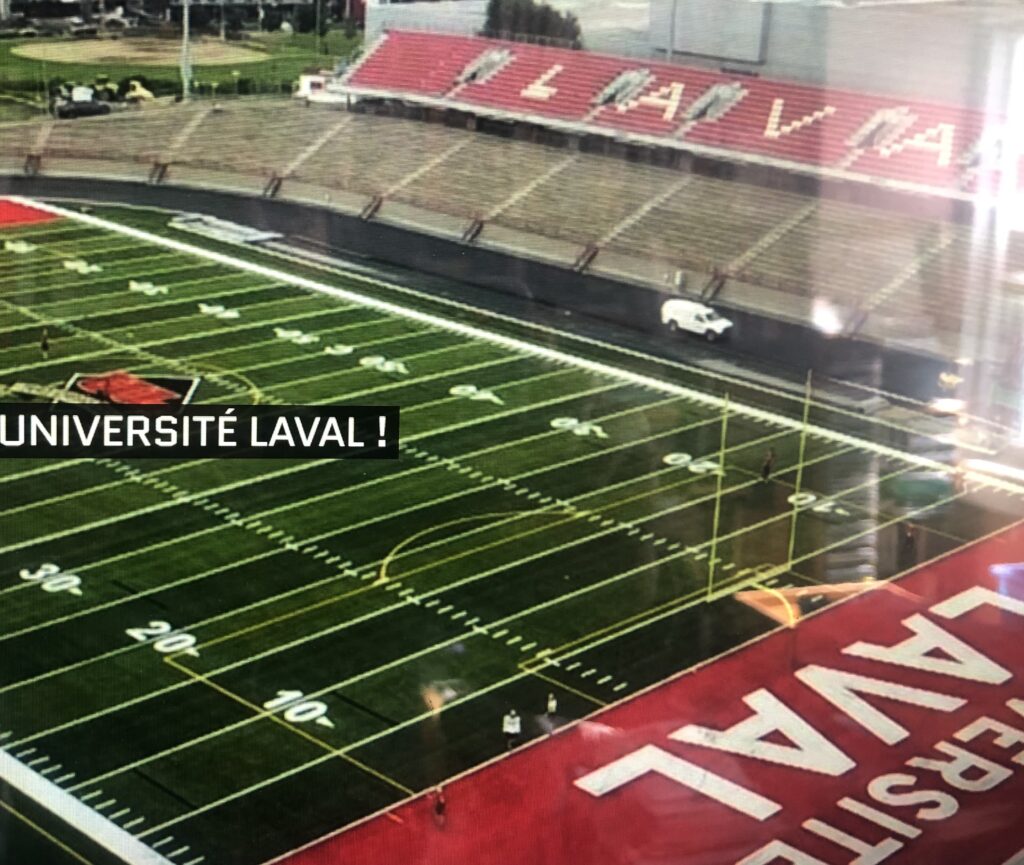
Telus stadium on Laval campus has hosted up to 20,000 fans for Quebec college football.
“There were good Quebecers when I started at the college level, but nothing like it is now,” he told the Alouettes team website in 2021. “With the success of the [U de M] Carabins and the [Laval] Rouge et Or, it snowballed. It influenced the other universities to raise their level of play. McGill, Sherbrooke and Concordia University have improved a lot, which is excellent for Quebec football,” he said.
“Just think of Laurent Duvernay-Tardif who went to the Super Bowl [in 2020] and Antony Auclair who participated [in 2021].” Duvernay-Tardif played at McGill, while Auclair is a product of the top-ranked Laval program.
Sidy Sow of Granby followed in Deslauriers’ path, first as a Champlain College star then an Eastern Michigan grad. Today, Sow is an offensive lineman with the New England Patriots. Still, these Quebec players make up just 0.17 per cent of NFL rosters.
In the CFL, fans are still waiting for a French Quebec superstar. There are exciting players – including Marc-Antoine Dequoy, a flamboyant, long-haired defensive back on the Alouettes, and Mathieu Betts of the B.C. Lions, the league leader in quarterback sacks.
But there has not yet been a native son in the mould of QB Anthony Calvillo or running back Johnny Rodgers —stars who could top the sports news, draw fans to the stadium, and lift crowds to their feet.
Hold on to your gin, that day may soon be coming.
Originally published in the Sherbrooke Record weekend edition, Oct 7, 2023.
Update:
TSN’s CFL analyst Dave Naylor does due-diligence in mid-2025 on sources of football talent in Canada, and finds that Quebec universities have surged to the top:
https://www.tsn.ca/cfl/from-dave-naylor-a-closer-look-into-where-the-cfl-finds-its-talent-1.2336226
Two programs in Quebec represent the biggest change we’ve seen in CFL player development over the past 25 years
The University of Montreal led all Canadian schools with 14 players on opening-week CFL rosters, two more than any other school – one of which is Laval with 12.
The fact that the Montreal Carabins football program did not exist 25 years ago and Laval’s didn’t exist 30 years ago illustrates how quickly the development of French-Canadian talent has emerged over that time. With 26 players collectively, the impact of the two programs has been immense, representing 11.5 per cent of all Canadian players in the league and 17.1 per cent of all players coming out of U Sports programs.
The rest of the top five include Guelph, which tied with Laval at 12, followed by Wilfrid Laurier and Alberta at 11 and 10, respectfully.
Among conferences, Ontario University Athletics leads the country with 58 players, followed by Canada West with 49, Quebec with 36, and the Atlantic University Sports with 14.
