Intuitive and enigmatic, cats have woven a place in our domestic life
Now that all the New Year’s chatter about “starting anew” and recasting the world in 2026 has quietly passed away, we can focus on one unchanging attraction: cats
Cats don’t rank with the political and social issues that usually engulf this column, but they remain a key part of our domestic life.
Facebook and Instagram overflow with cat anecdotes and videos, highlighting their crazy behaviour chasing sunbeams, or charming us as they tiptoe across computer keyboards or lounge on precarious ledges.
Angels and appeals
Since 2001, we have had seven cats total in our household, usually in pairs — Mistigri and Guizmo, GrayCat and Tyson, Bella then Juniper, and finally the great (but noisy) Max.
This has been a dynamic grouping. Misti was found in a stairwell, while Gray adopted us, moving in and refusing to leave. Bella tolerated the old guy Gray, but then ran away after rejecting the company of female arrival Juniper.
Many cats find a home through the humane networks of shelters and animal-protection societies that have taken root in the Townships and around the world.
Max came to us after an urgent appeal on Facebook in early 2018. He was a snow-covered walk-in at friends’ Montreal apartment. When it became clear the overcrowded SPCA would likely euthanize a stray cat, they advertised to find Max a home. Bingo.
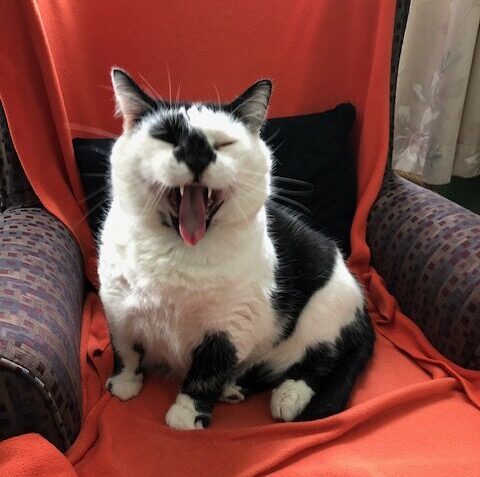
The black/white tuxedo-cat Max also had “angels” who established a fund for his dental work. After that trauma, he hid himself in obscure corners downstairs for weeks.
Intuitive and sensitive, cats often know more than we suspect. Once, as we stood looking over all the adoptable cats in their space at a local refuge, sitting watchfully in baskets or on ledges, I asked the shelter manager: Do they know what we are here for?
She replied immediately: Oui.
Animal rescue
In the Townships, Frontier Animal Society is a leading shelter, housed in a low-rise structure in the countryside on route 247 north of Stanstead. Cats wander about and climb steps high up the wall for their comfort and privacy. During a walk-through, some are friendly right away, others standoffish. The facility includes an indoor/outdoor “catio” porch that allows the animals to take in fresh air and sunshine.
On December 21, I met with Linda Peacock, who runs adoptions there. She told me that, while there are “usually 30” cats in-house, there were 40 cats boarded at Frontier in late 2025.
Adoptions vary by season: in 2025 there were 29 adoptions during winter, 32 in spring, 60 in summer then roughly 40 more through Dec. 21st, for a projected annual total of about 160 adoptions (compared to an annual average of 150). However, in its Jan. 4th Facebook post, Frontier announced it had reached a record total of 180 adoptions.
Frontier is selective in allowing adoptions: no animal can go to a small residence for reasons of its welfare, nor to students, as they move often and create instability for pets.
Some cats are hard and/or impossible to adopt, Peacock points out Tasha, a “true ferral” found outdoors who withdraws instantly from the touch. Other cats have problems that turn off potential families, including infections, notably FIV or feline AIDS, which are in fact benign for humans.
Peacock looks grim at the mention of people who abandon their pets (“you don’t want to know”, she frowns), but that remains a common and obnoxious practice.
To help remedy that, Frontier has 7-8 diligent volunteers, coming from a radius bound by Way’s Mills, Ayer’s Cliff, Ogden and Fitch Bay. A veterinarian in Coaticook does sterilizations once a month. This is “the key” to animal welfare, contends Peacock. Vets are highly trained and certainly not free, but the shelter gets a 10 per cent discount; each operation costs about $70. There were also nine cats in the sick bay the day we visited.
Cats are a fun part of the family life but increasingly expensive these days. High bills from vets are a necessary toll. Sick and ageing animals often require premium food. Kibble for cats suffering, say, gastrointestinal or hyperthyroid issues, can be well over $100 a bag.
As for other shelters in the Townships, Peacock likes the work of Refuge Le Château (https://refugelechateau.weebly.com/ ) in Sherbrooke. There is also the high-volume SPA de l’Estrie (https://spaestrie.qc.ca/en/about-us/ ), and the no-kill Refuge Notre-Dame-des-Bois in the Mont-Mégantic area, among other regional shelters.
The Blue Seal animal-food store at the edge of Lennoxville, a special case, is a privately run retailer housing a small group of adoptable feline residents. It boasts of “2300 lives saved” on its roadside sign.
Literary cats
There is a deep library of writing about cats. Much of it is too cutesy, but other books are far more serious and probing.
James Herriott is famous for the animal-themed stories that led to the TV series All Creatures Great and Small. These concern a veterinarian in Yorkshire, England, who encounters all sorts of tricky animal issues in his rural practice. His collection of feline tales, James Herriott’s Cat Stories (1973), merits a quirky place in feline lore.
A nephew forwarded me a copy of English philosopher John Gray’s book about cats, Feline Philosophy: Cats and the Meaning of Life (2020). As one reviewer puts it: “Gray discovers in cats a way of living that is unburdened by anxiety and self-consciousness, showing how they embody answers to the big questions of love and attachment, mortality, morality, and the Self”.
Gray writes about the philosopher Montaigne’s house cat, whose unexamined life may have been the one worth living; Meo, a Vietnam War survivor with an unshakable capacity for ‘fearless joy’; and writer Colette’s Saha, the feline heroine of her story “The Cat”, a parable about the pitfalls of human jealousy.
One prediction for 2026: cats will remain unpredictable.
Originally published in the Sherbrooke Record weekend supplement, Jan 9, 2026.
