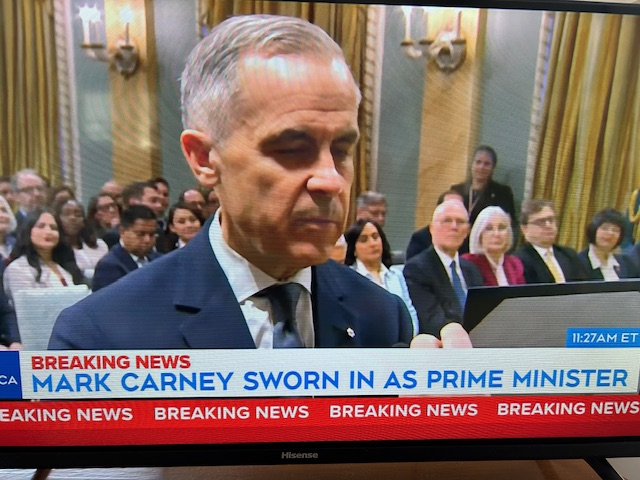
Mark Carney’s federal Liberals are already facing restless voters after broad promises. And provincial Liberals are challenging two-term CAQ government in Quebec.
Suddenly, everything is about politics — municipal, federal, provincial. What is going on?
I voted last Sunday in our municipal election in the Townships – for two council members and a mayor. And every day I followed the dramatic city vote in Montreal, where the municipal greens were thrown out. Now political attention shifts to looming provincial and perhaps federal consultations. Liberals everywhere are feeling the voter turbulence.
Federal follies
Even the federal Liberals?! you ask. —They were just re-elected!
Yes, the Mark Carney era started with great promise, and many high-minded goals. But eight months after he walked effortlessly into the lead role, Carney already has plenty of dissenters and naysayers. “Canadians can’t wait much longer for Carney to accomplish something”, trumpets impatiently the conservative National Post.
The federal budget of Nov. 4 had to match those hopes, while maintaining support for Carney’s minority government. Many were disappointed. A plurality of voters feel that Carney is either being “too soft or too reactive”, reports pollster Abacus Data. And a combative Opposition party looms.
To be fair, Carney pledged so many initiatives to so many constituencies that they are often self-contradictory . He wants Canada to be greener than green while pouring record amounts of concrete. Conciliatory to Indigenous peoples while ramming pipelines through northern forests right away. And fiscally responsible while racking up almost-Justin levels of debt, with more to come. One CBC panelist correctly called the tone of the budget “technocratic”, not populist. Something has to give, and opposition parties will point out every compromise.
Carney’s updated Liberalism took root in mid-2024. Liberal support had steadily slid downward following Covid lockdowns. Then, given steeply rising rents across the country, declining public services and very high immigration, Liberals lost a string of key byelections. Support hit rock-bottom.
The national electorate had caught anti-Justin fever. Already by late 2021, after a pointless election with stagnant results, I was arguing that Justin Trudeau’s best-before date had passed. It got worse throughout 2022 and 2023. His policies seemed increasingly improvised, self-absorbed and impractical.
Trudeau finally had to be forced out by his own Finance minister, who called the Holiday 2024 GST cut that the PM had forced into her budget “a gimmick”. She was far from the only woman to reject the “feminist” PM. Today, bad reviews from the Justin era keep pouring in. As former Environment minister Catherine McKenna noted in her recent memoir, Trudeau was entirely isolated from Cabinet. He only consulted regularly an inner circle comprised of a McGill cohort (Gerald Butts, Marc Miller) and a family mentor (Dominic Leblanc). He became politically tone-deaf.
Enter Mark Carney
Today, Carney is embroiled in a relentless series of negotiations to minimize the impact of U.S. protectionism. These well-meaning initiatives have been dogged at every step by a volatile White House and its midnight tweets. Will he be tempted to use his recent budget as a final offer to voters? Carney may want a new majority to support his more centrist Liberal vision, but he does so a great risk.
There is pushback to any notion of a winter election. As columnist Marc-André Leclerc warns in the weathervane Journal de Montréal: “Des élections, non merci!”
“While some may dream of a dramatic turn of events, this is mostly a political melodrama without any solid basis in reality …. the country needs governance, not election banners.”
One skeptical Globe reader added: “This country is sorely in need of a reset but I’m not sure what the catalyst will be. I had hopes for Carney, but he seems to be fizzling faster than a Toronto sports team in a playoff series”.
Ouch. Voters may have to decide in 2026 if he’s safe at home.
Quebec party rising
Things are clearer in Quebec. The dogmatic Legault-led Coalition Avenir Quebec (CAQ) is finished, and there will likely be a two-way battle to replace it in 2026.
If you regularly read the francophone press and its political analysts – notably the nationalist Journal de Montréal – talk of a “rising” Quebec political party sets your mind racing towards …. the Parti Québécois.
This is an old fixation of the media and political classes here. If the PQ shows any sign of life, they call the situation 1976 all over again (ask your parents). Many national and Toronto commentators are also subject to this delusion.
I had personal experience of this a decade ago, as the Pauline Marois PQ government launched its 2014 re-election campaign. Media folk threw up their hands: the PQ was rolling to victory again! I doubted that forecast and was repeatedly shouted down online. But the result was in fact a Quebec Liberal landslide.
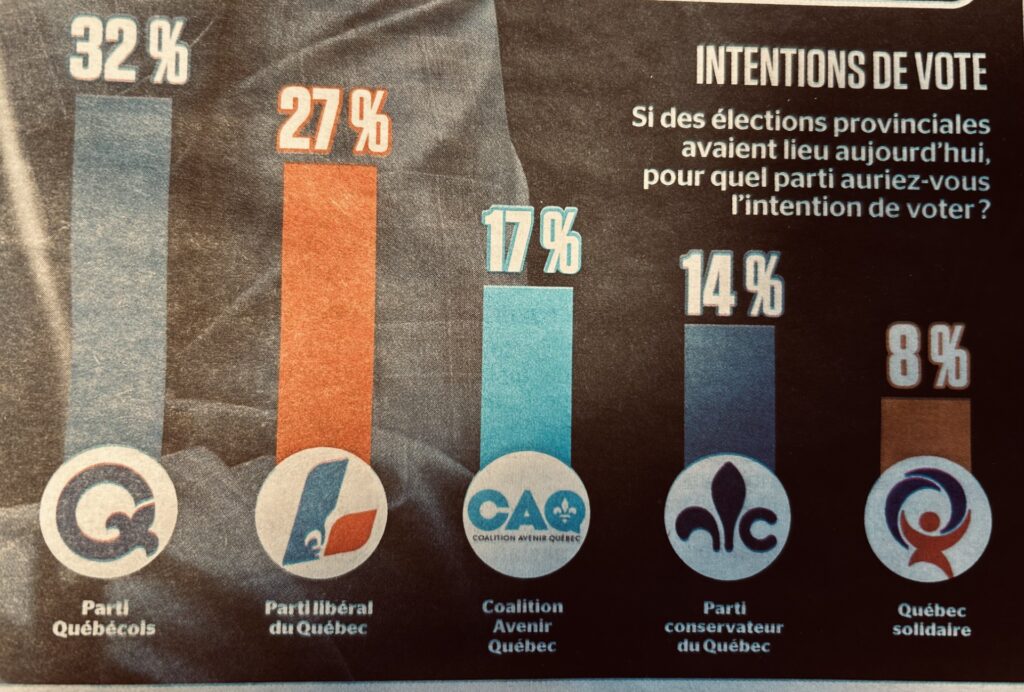
Today, political polls are clear: the Quebec Liberal Party has fully bounced back and is again headed for a direct confrontation with the PQ in 2026.
After its terrible 2022 election under a weak leader, the QLP finished with just 14.3 per cent support, behind the PQ, which had the support of 14.6 per cent of the vote. These two parties were tightly bunched with second-place Québec Solidaire (15.4) and last-place Quebec Conservatives (12.9) — all far behind the victorious CAQ.
Since then, the Liberals have quietly advanced, mirroring the steady collapse of the governing CAQ. Polls in mid-November 2025 showed the Liberals at 27 per cent support, while the PQ declined somewhat from its recent peaks:
Enter Pablo Rodriguez, giant killer?
Back in June at the Liberal leadership convention that elected Rodriguez in Quebec City, I was struck by one speaker recalling the feedback he received in door-to-door canvassing in 2022. Many potential voters, he reported, said “we have to give [the CAQ] a chance”.
By this they meant that Legault had made promises of pragmatic governance in 2018, but the government’s Covid lockdowns entirely upended any coherent policy. Give them another chance.
By 2025, with CAQ fiascos multiplying, that window had closed and voters welcomed new options.
Given this reversal of public sentiment, the Quebec Liberal Party is now clearly on the rise. In October a Léger survey reported that the Liberals polled at 25 per cent support, for second place overall. And, given the defiance of the Quebec electorate with regard to the PQ’s sovereignty goals, the Liberals have a wide-open door in front of them. Bring on the elections, say party supporters. Away we go.
In Israel people often ruefully repeat a weary adage: We have four seasons here: war, strikes, elections and summer.
In Canada, blessedly, there is no war. But the other three “seasons” are recurring fronts that sweep the country. Welcome to the political season. Dress warmly.
Original version published in the Sherbrooke Record’s weekend supplement, Nov. 7, 2025.
