Quebecers have long embraced a sports team that made them proud. Will it always hold their hearts?
With the return of the fall season, NHL hockey looms again, as imposing as ever in Quebec culture and society. You have to wonder: Are culture and sport the same thing here?
The death of Canadiens great Ken Dryden on September 5th sparked an outpouring of laments from unlikely sources — politicians, editorialists and health professionals. In addition to his hockey stardom, Dryden wrote a milestone book, The Game (Collins, 1983), one with real literary value. It painted the players and sport in a subtle tone, and avoided making heroes out of ordinary guys who happened to develop great athletic skill.
Dryden’s book helped hockey literature catch up, notably with baseball, which has long been a magnet for writers and bookish types, producing sports classics like The Boys of Summer and incisive journalism at the New Yorker level by John Updike and Roger Angell. Now Canada had a peer in that league.
Dryden made writing and thinking about hockey a Serious Thing. We need more of it.
Endless winning streak
My student days in the 1970s luckily fell amidst the Canadiens’ and Dryden’s endless Cup-winning streak. It felt like a magnetic field. Mordecai Richler had his alter ego in novel Barney’s Version skip out of his own wedding reception to check the score of a Bruins-Habs game. The Canadiens, he wrote, seemed to be “a spiritual necessity”.
The greatest Habs players, from Maurice Richard to Jean Béliveau and Guy Lafleur, each mirrored and expressed Quebec society. As Globe writer Scott Disher wrote when Lafleur suddenly left the team in 1984, Richard evoked Premier Duplessis and the “dark and Catholic” world he grew up in, while Béliveau was a dapper 1960s gentleman akin to reformist Premier Jean Lesage. Finally, the mercurial Guy Lafleur echoed charismatic René Lévesque, able to single-handedly bring a Forum crowd to its feet with an electrifying performance.
These heroes have been canonized by the Canadiens’ talented promotions team, one which, quips sportswriter Michael Farber, does ceremony “better than any institution outside the House of Windsor”.
Sports as regional identity
Sports fans today often have a supersized identification with their teams.
In the film The Day after Tomorrow, a 2004 climate-disaster thriller, for example, the oceans rise and winds blow wild. At a remote Scottish climate-research centre, the generator suddenly breaks down. Three British scientists, stranded and facing doom, break out their bottle of Balvenie Doublewood 12-year-old whisky, and raise a final glass together. They give cheers first “to England”, then “to mankind”, and finally … “to Manchester United”.
Like English football’s Manchester United, historic Canadian NHL teams the Toronto Maple Leafs and the Canadiens each inherited a hardcore following rooted in their community and region. As with England’s football teams, players often came from nearby working-class neighbourhoods.
Globalization, however, has hugely impacted pro sports. Cities and regions are now just called “markets”. Teams have become steadily more rootless. By 2003, big-money London club Chelsea fielded a side with no native-born English players.
Q.: Does team identity matter anymore?

The 1993 Cup…. and then what??
The Canadiens faded badly after their last Stanley Cup in 1993. By the early 2000s there were doubts about the club’s ownership and even its survival. A buyer for the franchise was not easily found — even at bargain-basement prices. Finally, an American capitalist took the bait.
The sports public in Montreal, however, has an insatiable appetite for hockey, one that is not easily quenched. Today in 2025 there are even summertime podcasts devoted to little but the prospects for the Canadiens’ second line.
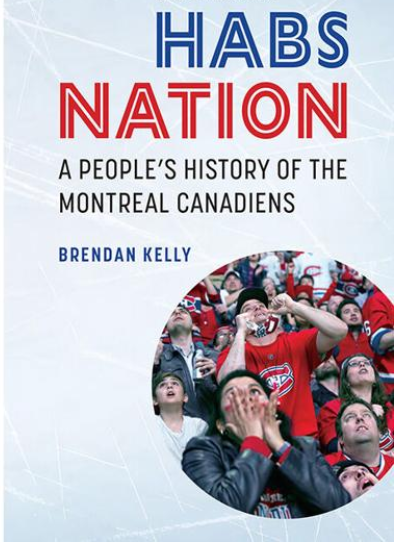
A new work by a devoted fan and outspoken contrarian, Brendan Kelly, Habs Nation: A People’s History of the Montreal Canadiens (Baraka, 2025), analyses this attachment.
Kelly insists on the social and political dimension of Canadiens fandom. This is a welcome take in the politically agnostic world of sports journalism. He notes, for example, the odd coincidence of deep slumps for the Canadiens after 1980 and 1995 — two years with tumultuous referendum campaigns.
Kelly’s take is often glass-half-empty; I am usually glass-half-full. I tolerated former general manager Marc Bergevin’s mixed results in the 2010s, given his star goalie, their division championships and run to a Stanley Cup final. Kelly skewered the GM for all his middling teams and lack of consistency or long-term plan.
Kelly focuses here on the Canadiens’ French tradition – it was founded in 1909 as a rival to English and Irish Catholic squads — and how the team’s lack of success in recent decades has, to some extent, been correlated with the decline in its francophone content.
Sports-site posters regularly say, “I couldn’t care less the nationality, language, whatever of the players – just win”. This is a standard Anglo argument, audible whenever there is lobbying for, say, a francophone coach or player.
But some statistical research on the Canadiens, argues Kelly, shows that CH teams with higher French content have succeeded more often. He highlights specifically the last Cup winner in 1993. There were then 14 francophone players on GM Serge Savard’s squad — some games today there are none — after he had made a point of scouring Quebec minor leagues for help.
Kelly underlines other Habs GMs’ failures to draft obvious Quebec Major Junior league stars, notably Denis Savard in 1980 and Patrice Bergeron in 2003. I would add their extreme carelessness in ignoring Laval scoring ace Mike Bossy, available in 1977; he might have powered more ‘80s championships, as he did with the Islanders. Likewise, disastrous trades, especially that of franchise legend Patrick Roy, led to lengthy rebuilds.
Did Canadiens’ managers, by then running a billion-dollar operation, gradually decide that global sports success meant downplaying local talent?
To be fair, Montreal fans’ yearning for local stars has led to other fiascos, notably drafting the disappointing Louis Leblanc and trading for flashy but volatile Jonathan Drouin.
Kelly bravely shines a light on these gross failures of the Canadiens, but also stresses their need for rootedness. A tricky balancing act.
As the 2025-26 season begins, we can only wonder, with Kelly: where are the Canadiens (and Quebec society) headed? Ken Dryden must be wondering.
This article originally appeared in the Townships Weekend supplement to the Sherbrooke Record on October 3, 2025.
